A2 or A4 - which stainless steel
The price gap between A2 and A4 can run into double-digit percentages. One way you overpay; the other you replace the fasteners early. And with some timbers neither grade is the right question - this guide covers that too.
What the markings mean
A2 is austenitic stainless steel for outdoor use without chemical loading. A garden structure, a summerhouse, a facade away from the coast - A2 does its job there.
A4 adds molybdenum. That is what lets the steel cope with chloride environments in which A2 starts to pit - locally and inward, rather than evenly across the surface. Pitting is more dangerous than a surface bloom because it weakens the cross-section without changing the head.
Both are stainless, but stainlessness is not a yes-or-no property. It is resistance to a particular environment, not resistance to everything. A screw described only as “inox” with no grade tells you almost nothing - and the difference between A2 and A4 can decide how long the whole deck lasts.
When you genuinely need A4
- The coastal strip - salt in the air, not only right on the beach.
- Around winter-salted roads - salt aerosol travels further than people expect.
- Outdoor pools and the structures around them.
- Timber held at permanently raised moisture, with no chance to dry.
The manufacturer says it explicitly for A4 screws: suitable “for use in salt-bearing atmospheres”. For A2 it depends on the family - Paneltwistec A2, for example, is described by the manufacturer as “conditionally suitable for salt-bearing atmospheres”. The whole difference lies in the word “conditionally”, so with A2 always read the data sheet of the specific screw.
When A4 is not enough either
This is the part sellers stay quiet about. The manufacturer excludes A4 screws from chlorine-bearing atmospheres - quoting the documentation: “not suitable for use in atmospheres containing chlorine”. In practice that means indoor swimming pool halls.
Airborne chlorine attacks steel differently from sea salt, and solutions there sit outside the standard range. If you are building a timber structure over an indoor pool, no screw from this shelf is the right one - neither A2 nor A4. Write to us before you order.
Pitting - why this is not ordinary rust
It is worth understanding what molybdenum protects against, because it changes how you look at a deck.
Stainless steel is not durable because it fails to react. It is durable because chromium forms a thin oxide layer on the surface that rebuilds itself after a scratch. Chloride ions can breach that layer at a point, and pitting begins: a narrow hole running inward, inside which the environment turns more aggressive still.
The practical consequence is unpleasant: pitting does not look like rust. The head can be clean while the shank, buried in the board, is weakened. That is why, where salt is present, you do not judge a joint by its head - and why, with salt, it is better to pay for A4 at the outset than to check later.
Service classes under Eurocode 5
The manufacturer’s documentation works in service classes 1, 2 and 3 to EN 1995-1-1 - the language a designer speaks. The class is set by the moisture content of the timber, not by the name of the building - the examples below are typical, not automatic.
- Class 1 - moisture content corresponding to 20 °C and a relative humidity exceeding 65% only for a few weeks a year; most softwoods stay below 12%. Example: heated interiors.
- Class 2 - moisture content corresponding to 20 °C and a relative humidity exceeding 85% only for a few weeks a year; softwood up to 20%. Example: carport, unheated loft.
- Class 3 - climatic conditions leading to higher moisture content than in class 2. Example: decking, an unprotected facade.
For most screw families the manufacturer permits A2 and A4 in all three. That matters, because some structural fasteners are limited to classes 1 and 2 - and then they must not be used outdoors, however sufficient the load capacity. Capacity and durability are two separate questions.
The third grade this question forgets
“A2 or A4” assumes the choice has two elements. It does not. Beside them stands hardened stainless steel - martensitic 1.4006, steel group C1 - and it is what goes into decking screws for hardwood. “C1” here is a steel group under ISO 3506, not the atmospheric corrosivity category C1 of EN ISO 9223 - the same characters, an entirely different concept.
Its advantage is mechanical, not corrosive: the manufacturer states a 60% higher breaking torque than A2 and A4. In hard timber an ordinary stainless screw shears its head off before reaching full depth; the hardened one goes in.
The price sits on the corrosion side. Hardened steel is conditionally corrosion resistant and not acid resistant. It is neither a “better A2” nor a “worse A4” - it is a different axis.
Tannins: the second axis, decided by species
A widespread shortcut needs correcting here, one we repeated ourselves: “the steel grade follows the conditions, not the timber species”. That is false, and it is worth knowing why.
Conditions settle the choice between A2 and A4. But the species settles whether a grade is admissible at all - because tannins act on steel chemically, whether or not there is salt in the air.
| Steel grade | What the manufacturer writes about tannin-rich timber |
|---|---|
| Zinc plated | Out. Tannins react with zinc - described in the guide to the black stains. |
| Hardened C1 | “Not suitable for timber with a high tannin content such as cumaru, oak, merbau, robinia etc.” |
| A2 | It depends on the family: some data sheets carry the excluding formula, one the softened “conditionally suitable”, and the data sheet of the screw for the Drill Tool 50X warns of possible discolouration of the timber and the screw. |
| A4 | The only one stated as “suitable for fixing tannin-bearing timber species” - without condition. |
So for oak the answer is A4, regardless of whether the deck stands by the sea or a hundred kilometres inland. For Siberian larch the manufacturer, in a separate recommendation, rates hardened steel as perfectly adequate except in atmospheres with salt or chlorine - details in the guide to larch decking.
What we stock - honestly
We write this plainly, because a guide that ends by recommending a product off the shelf is advertising, not guidance.
| Grade | With us |
|---|---|
| Hardened stainless C1 | Hapatec silver and black, Hobotec |
| Austenitic A2 | the screw for the Drill Tool 50X (no. 905514) - our only A2 item, bought separately from the jig |
| Austenitic A4 | not in our range today |
| Galvanised / special coating | KonstruX, Topduo - structural work, not an oak deck |
If your case calls for A4 - oak, a coastal strip, salted roads - write to us with the species and location. We will source the right item, or have the manufacturer confirm whether a cheaper grade is enough in your case. We prefer that to handing you a substitute whose documentation says otherwise.
Installation: austenitic stainless is soft
Austenitic stainless is softer than hardened. In hard timber and at larger diameters, pre-drill, or you will shear the head. It is the most common complaint with A2 and A4 screws and almost always comes from skipping that step.
Pre-drilling applies to hardened screws too - the manufacturer recommends it for hardwood and in decking and facade construction, and writes it with an exclamation mark. Higher breaking torque gives margin on torque, not against splitting the timber.
When paying extra for A4 does not pay off
Honest in the other direction as well: A4 is not “always better”. On a pine garden structure a hundred kilometres from the sea, under a roof, you are paying for resistance nothing will test. Molybdenum improves neither strength nor driving.
The difference earns its keep where the environment actually carries chlorides or the timber carries tannins. Otherwise A2 is enough - and in hard timber without tannins the hardened grade is often a better choice than either, because the problem there is torque, not corrosion.
When the conditions are ambiguous
Sometimes a deck fits no simple description: ten kilometres from the sea but beside a winter-salted road; roofed but with no airflow. Do not average in such cases - work from the worst single factor, not the sum of them. If any one of them alone calls for A4, the decision is already made.
A second approach when you are still unsure: look at what corrodes nearby. Railings, fences and brackets that have stood there for years say more about the environment than a distance to the coast read off a map.
Three mistakes when choosing a grade
- “Stainless is stainless.” A2 in a coastal strip is at risk of pitting. A4 contains molybdenum and has higher pitting resistance; how many years that buys depends on the specific site and cannot be given as a single number.
- Choosing the grade without asking about the species. With oak the conditions are secondary - tannins decide first.
- Mixing metals in one joint. The more dangerous combination is the counter-intuitive one - a galvanised screw in a stainless fitting, because the zinc then corrodes faster. The simplest rule is one material throughout the connection.
In short
Conditions settle A2 against A4: A2 in a normal garden, A4 where there is salt. Species settles whether a grade is admissible at all: with tannin-bearing timber, A4 is the only one without a caveat. Over an indoor pool, neither - ask for a dedicated solution there. Hardened steel is the third path: mechanically the best in hard timber, chemically the weakest. Whether to pre-drill depends on the timber and the product - Paneltwistec A4, for example, goes into softwood without pre-drilling, but in hardwood, on decks and on facades, pre-drill.
Product from this guide
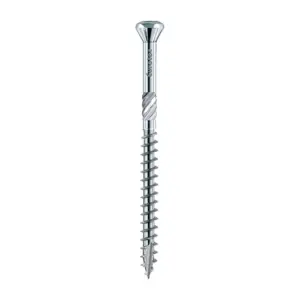 Hapatec stainless - decking screw for hardwood, hardened stainless steel
144,62 zł - 363,69 zł incl. VAT
Hapatec stainless - decking screw for hardwood, hardened stainless steel
144,62 zł - 363,69 zł incl. VAT
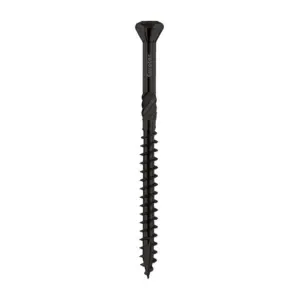 Hapatec black - screw for cladding and decking boards
159,11 zł - 496,38 zł incl. VAT
Hapatec black - screw for cladding and decking boards
159,11 zł - 496,38 zł incl. VAT
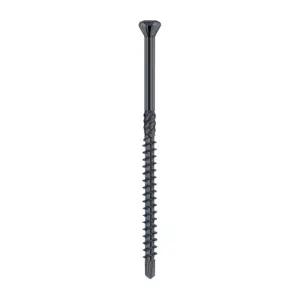 Hobotec ornamental head, hardened stainless steel, black
355,16 zł - 615,14 zł incl. VAT
Hobotec ornamental head, hardened stainless steel, black
355,16 zł - 615,14 zł incl. VAT
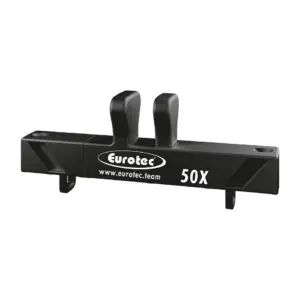 Drill Tool 50X - jig for invisible decking fixing
74,10 zł - 204,46 zł incl. VAT
Drill Tool 50X - jig for invisible decking fixing
74,10 zł - 204,46 zł incl. VAT
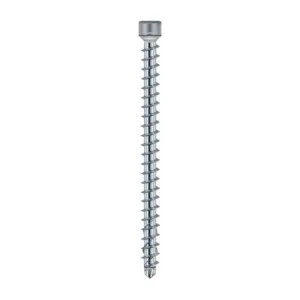 KonstruX Full Thread - Cylinder Head
102,43 zł - 789,03 zł incl. VAT
KonstruX Full Thread - Cylinder Head
102,43 zł - 789,03 zł incl. VAT
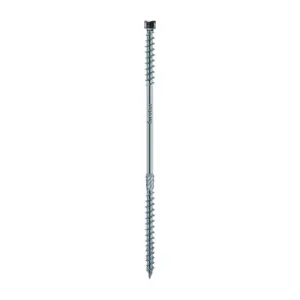 Topduo Cylinder Head - Above-Rafter Insulation
147,00 zł - 974,92 zł incl. VAT
Topduo Cylinder Head - Above-Rafter Insulation
147,00 zł - 974,92 zł incl. VAT