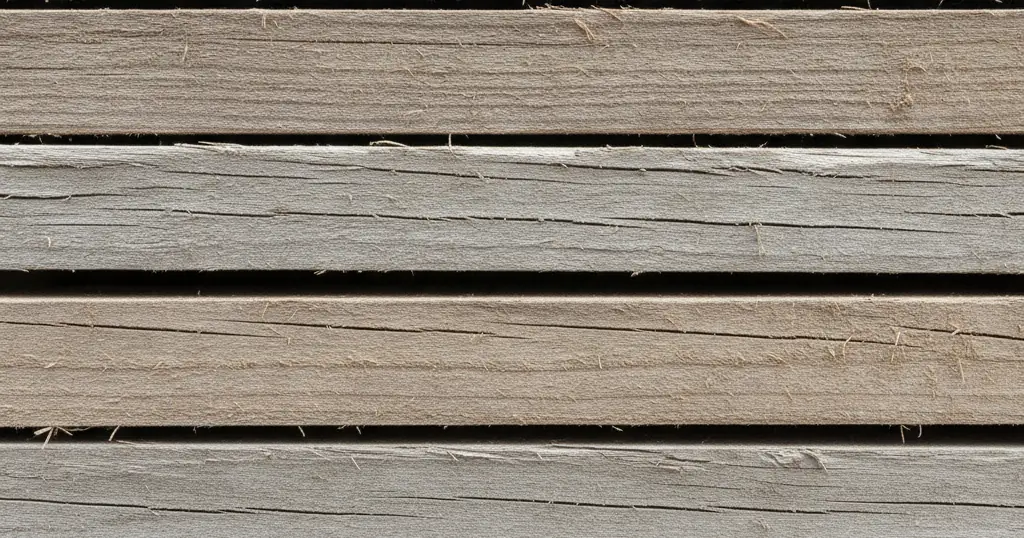
Larch decking - what to fix it with
Larch is a popular decking timber, and also one where getting the fastener wrong is expensive. Tannins, board density and movement rule out most hardware-store screws - and for Siberian larch the manufacturer has issued its own fastening recommendation, which this guide draws on.
Why larch is difficult
- Tannins. With moisture they react with zinc and leave black streaks around the head. Not only a matter of looks: acidic, wet timber also speeds up corrosion of the zinc and the steel beneath, so durability is at stake too. More in the guide to zinc and tannins.
- Density. The manufacturer describes Siberian larch as timber with very narrow growth rings and a high density for a softwood, and its hardness as moderate. Such a board splits easily at the edge without a pilot hole.
- Movement. A deck board moves all year round. The fastener has to tolerate that, not force the board rigid.
Stainless is not a choice, it is a condition
With larch the question is not “whether stainless” but “which one”. Galvanised is out because of the tannins. The type and thickness of the coating affect how quickly the problem appears, but they do not remove it.
Two things decide the steel grade at the same time. The environment decides whether hardened steel is enough or whether A2 or A4 is needed - see our A2 and A4 guide. The species decides whether a grade is an option at all. For Siberian larch the manufacturer has issued a dedicated recommendation, which we cover below under tannins.
Pre-drill - hardened steel included
Hardened steel tolerates more torque than classic stainless - for Hapatec the manufacturer states a 60% higher torsional breaking moment than austenitic A2 and A4. That does not mean pre-drilling can be skipped.
The screw’s data sheet says plainly: “pre-drilling is recommended for hardwood, in decking and facade construction”. A deck meets that condition whatever the species. The Siberian larch recommendation goes further: pre-drilling and countersinking is “absolutely recommended” there. Countersinking reduces chip build-up around the head.
Do not cut this step. On a larch board, especially near the edge, skipping pre-drilling ends in a split along the grain or a damaged fastener - and you only see either once the board is already screwed down.
Careful: hardened is not the same as A4
A decking screw made of hardened stainless steel is martensitic steel 1.4006, steel group C1 - the manufacturer describes it as conditionally corrosion resistant and excludes it from aggressive environments containing salt and chlorine.
For Siberian larch the manufacturer says the same from the other side: hardened stainless is adequate, but that assessment does not take the environment into account. In atmospheres containing salt or chlorine it recommends an A2 or even A4 screw instead.
- Salt - coastal areas, the surroundings of roads salted in winter: the hardened screw is out, A2 or A4 is the option.
- Chlorine - careful here. The data sheets of A4 screws exclude chlorine-containing atmospheres, in practice indoor swimming pool halls. A deck next to an outdoor pool and a pool hall are two different cases - for the hall, write to us before you order.
Tannins: what the manufacturer actually says about each steel grade
| Steel grade | What the manufacturer writes about tannin timber |
|---|---|
| Galvanised | Out. Tannins react with zinc - this is not a question of corrosion class but of chemistry. |
| Hardened (C1, 1.4006) | Data sheet: “Not suitable for timber with a high tannin content such as cumaru, oak, merbau, robinia etc.” Larch is not on that list, and the Siberian larch recommendation rates hardened steel as perfectly adequate - except in atmospheres with salt or chlorine. |
| Austenitic A2 | Depends on the family. For the screw used with the Drill Tool 50X the data sheet says that with timber containing tannic acids “discolouration may occur on the surface of the timber and the screw”. |
| Austenitic A4 | “corrosion resistant and acid resistant, and suitable for fixing tannin-bearing timber species”. |
Siberian larch. In a recommendation dedicated to this species, the manufacturer states that hardened stainless steel is perfectly adequate for Siberian larch decking. The caveat is the environment - salt and chlorine, as described above, and acidic conditions, since hardened stainless steel is not acid resistant. Away from the sea and salted roads, the hardened screw is in line with the manufacturer, not a compromise.
European larch. The same recommendation covers Larix sibirica and says nothing about European larch. We do not transfer it: silence is not approval. For European larch boards write to us - we will have the application confirmed by the manufacturer or point you to A4, where approval for tannin timber comes without conditions.
Visible or hidden fixing
| Method | When | What you need |
|---|---|---|
| Screw from the top | everyday deck, simple installation, easy board replacement | decking screw - hardened for Siberian larch, A2 or A4 where there is salt |
| Hidden fixing | when looks matter - but not for Siberian larch (manufacturer: visible fixing only) | installation jig + the screws for it |
In the Siberian larch recommendation the manufacturer writes that boards of this timber are not suitable for indirect fastening because of their swelling and shrinkage behaviour, and recommends only visible screw fixing for them. Before you fix Siberian larch invisibly, ask the board supplier or us.
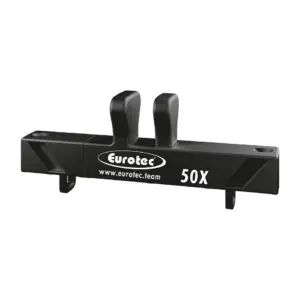
Hidden fixing drives the screw at an angle, through the side of the board; the jig sets the angle and depth.
The Drill Tool 50X sets a 50° angle and keeps a 6 mm gap between boards by itself. The tool is designed for boards from 21 mm thick and 110-150 mm wide, but for softwood the manufacturer recommends boards 21-25 mm thick and 110-145 mm wide.
Note when ordering: this is not a boxed kit. The tool needs four items, and we list each one separately - the drill bit and driver bit are consumables:
- 50X jig - the tool itself (no. 499985),
- 50X step drill 3.3-4.5 mm - it does the pre-drilling,
- 50X A2 decking screw 4.2 × 60 mm (no. 905514, 250 pieces),
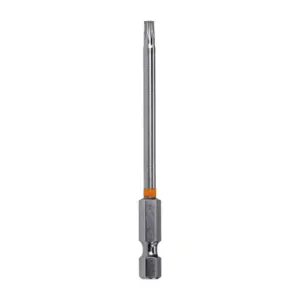
- 50X long bit TX 15, 82 mm long - a standard 25 mm bit does not reach the head, because the tool guides the bit through its body.
The screw for this tool is A2, an austenitic steel, more corrosion resistant than hardened martensitic steel. The 50X data sheet does not, however, confirm this screw for salt exposure - near the sea, ask us before buying. With tannin timber, however, the manufacturer warns of possible discolouration of the timber and the screw.
Black head or silver
Unoiled larch turns grey within one or two seasons. A silver head, barely visible on a fresh board, starts to stand out as bright dots on a greyed one. A black head does the opposite - it disappears over time. If the deck is to stay natural, without oil, a black head ages along with the timber.
Spacing, gaps and fixing to the joist
For Siberian larch the manufacturer gives specific values in its fastening recommendation:
- Joist spacing: maximum 60 cm centre to centre.
- Gap between boards: 6-8 mm. A board moves across the grain, and the gap has to absorb swelling after rain. A deck laid too tight pushes the boards up, and the fastener will not stop that.
- Gap at butt joints: 3-4 mm - the manufacturer stresses that this range should be neither undercut nor exceeded.
- Distance from the board end. Larch splits along the grain most readily at the end of a board - here pre-drilling is a requirement, not a recommendation.
For European larch this recommendation gives no values; take them from the board supplier.
Oil, greying and the fastener
Oiling does not change the requirements for the steel. Oil slows greying and reduces water uptake, but it does not cut the tannins off from the fastener. Galvanised under oil leaves the same stain, just later.
Siberian and European larch
“Larch” in decking offers means two species, and the manufacturer’s documentation covers only one of them.
Siberian larch (Larix sibirica) has its own description in the manufacturer’s recommendation: very narrow growth rings, a high density for a softwood, low swelling and shrinkage, low resin content. All the values in this guide refer to it.
European larch appears there only in the note on colour, with no installation instructions, so we make no claims about its hardness or warping. It is a tannin timber with respect to zinc too, so galvanised is out in both cases.
Three mistakes that cost a season
- Screwing right at the board edge. Larch splits along the grain. Keep your distance from the end and the edge - the same applies to any hard timber.
- Overtightening. A head pulled deep into the board forms a cup that holds water. The head should sit flush with the surface, not sink below it.
- Mixing metals in one joint. The worst combination is the counter-intuitive one: a galvanised screw in a stainless fitting, because the zinc then corrodes faster. Keep one material throughout the joint.
What to order - specifically
| Situation | Item |
|---|---|
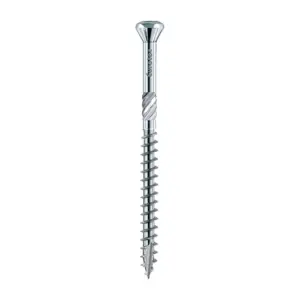
| Siberian larch, visible fixing, typical environment without salt or chlorine | Hapatec silver - hardened stainless, TX 15-25, Ø 4.0-5.0 mm, 30-100 mm |
| The same, but the deck is to grey naturally | Hapatec black - the same screw with a black head, 35-100 mm |
| No visible heads - A2 screw; with tannins the manufacturer warns of possible discolouration, and for Siberian larch it recommends visible fixing | Drill Tool 50X - four items separately: jig, drill, A2 screw and 82 mm bit |
| Trims and fascias around the deck - not the boards | Hobotec black - Ø 3.2 mm, decorative head; the manufacturer intends it for trims and cover strips, not decking boards |
| Coastal area, salted roads | hardened is not enough - you need an A2 or A4 screw; write to us with the location |
| Indoor pool hall | neither hardened nor A4 per the data sheet - write to us before ordering |
| European larch, or you want a grade with an unconditional “suitable” for tannin timber | A4 - not in our range today; write to us and we will source the right item |
You will find the full range in the decking screws category.
What this guide does not settle
Board thickness and joist cross-section - these depend on the deck design, not on the fastener. If the structure under the boards carries a calculated load, you need documented properties of the fastener; when that is necessary is covered in our guide to ETA.
In short
Larch: galvanised is always out - for looks and for durability. For Siberian larch the manufacturer rates hardened stainless steel as perfectly adequate in a typical environment; with salt it recommends A2 or A4, and an indoor pool hall needs a separate choice. Joists at most every 60 cm, gap 6-8 mm, butt joints 3-4 mm, pre-drilling with countersinking. For European larch the manufacturer does not issue this recommendation - write to us with the species and location, and we will confirm the application instead of guessing.
Product from this guide
 Drill Tool 50X - jig for invisible decking fixing
74,10 zł - 204,46 zł incl. VAT
Drill Tool 50X - jig for invisible decking fixing
74,10 zł - 204,46 zł incl. VAT
 50X long bit TX 15, 82 mm - for the Drill Tool 50X
56,94 zł incl. VAT
50X long bit TX 15, 82 mm - for the Drill Tool 50X
56,94 zł incl. VAT
 Hapatec stainless - decking screw for hardwood, hardened stainless steel
144,62 zł - 363,69 zł incl. VAT
Hapatec stainless - decking screw for hardwood, hardened stainless steel
144,62 zł - 363,69 zł incl. VAT
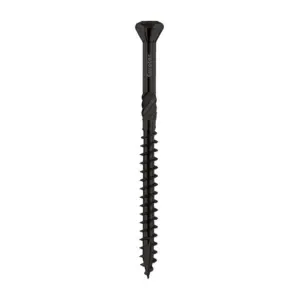 Hapatec black - screw for cladding and decking boards
159,11 zł - 496,38 zł incl. VAT
Hapatec black - screw for cladding and decking boards
159,11 zł - 496,38 zł incl. VAT
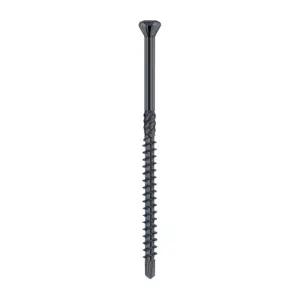 Hobotec ornamental head, hardened stainless steel, black
355,16 zł - 615,14 zł incl. VAT
Hobotec ornamental head, hardened stainless steel, black
355,16 zł - 615,14 zł incl. VAT