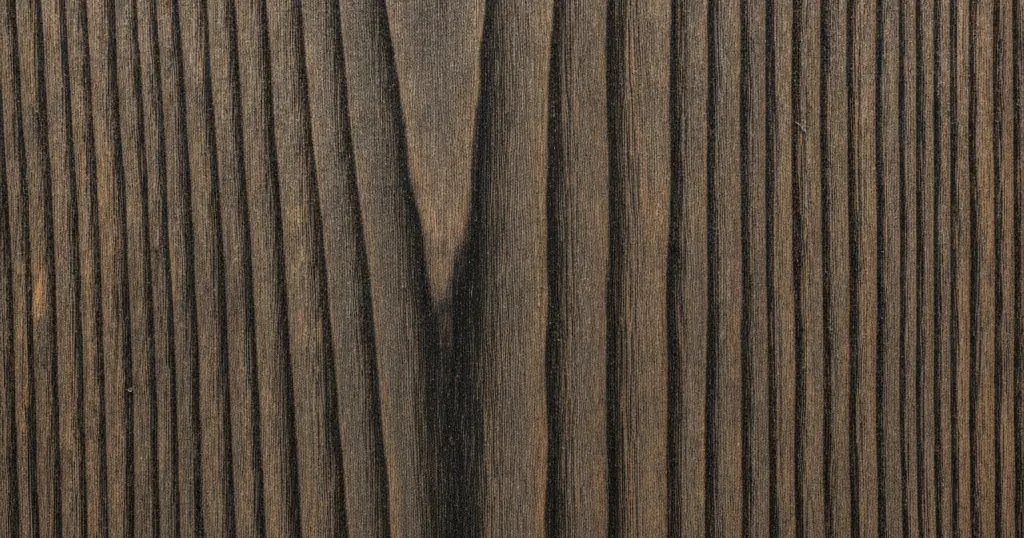
Oak, larch, thermowood - why zinc leaves black stains
The structure is sound, the screws hold, and after the first rain a black ring appears around every head and runs down the board. This is not workmanship and not a bad batch. It is a chemical reaction that one decision at ordering would have avoided.
What is actually happening
Oak, larch, sweet chestnut and thermally modified timber contain tannins - the tree’s natural defence against fungi and insects. In the presence of moisture, tannins react with the zinc of a galvanised coating.
The reaction products are dark tannates - salts of tannic acids with the metal. They soak into the timber around the fastener and run off with the water, leaving the characteristic streaks downward.
Two sources of colour are worth separating, because confusing them leads to a wrong diagnosis. Zinc alone gives a greyish to dark grey discolouration. The deepest, ink-like black appears where tannins reach iron - the steel beneath the coating, exposed at the drive recess, at a drilled edge, or wherever the layer was rubbed away while driving. That forms iron tannate, the same compound that was the basis of iron gall ink.
The practical conclusion is one and the same: a galvanised fastener stains tannin-bearing timber. The coating is not intact exactly where the driver does its work.
It is worth knowing that tannins are neither a contaminant nor a defect of the material. That is why tannin-rich species are also the most durable outdoors. Buying oak or larch for a deck, you buy that durability together with the problem it creates for zinc. The two come as a pair and no better batch of timber will separate them.
The stain does not sit on the surface - it soaks into the wood, so a light sanding will not take it off. Oxalic acid usually lightens or removes it, but it comes back as long as the source of iron stays in the board. Replacing the screws alone will not remove discolouration that has already formed. This defect is cheap to avoid and laborious to repair.
Telling a tannin stain from ordinary rust
Two different problems look alike from two metres away and call for different responses.
- The tannin reaction is blue-black to graphite, has a sharp edge around the head and forms streaks downward, following the water. It appears fast - after the first proper rain, not after a season. The screw itself looks immaculate.
- Rust is red-brown, blurred at the edges, and starts from the fastener, which visibly changes. It builds over months.
A clean head with black wood around it points to a reaction between metal and tannins, but does not prove it - mould or iron filings, for example, can look similar. Confirm it with a test: an oxalic acid product on a hidden spot usually clearly lightens an iron-tannin stain. Swapping to stainless stops new stains but does not undo the ones already there.
Which species
| Timber | Risk |
|---|---|
| Oak | high - the classic case, named by the manufacturer |
| Larch | high, Siberian especially |
| Sweet chestnut | high |
| Cumaru, merbau, robinia | high - the species named in the manufacturer’s exclusions |
| Thermally modified timber | raised |
| Cedar | raised |
| Pine, spruce, fir | low |
This table concerns the reaction with zinc. You will see in a moment why it is not the same list as the one where the manufacturer restricts stainless steel - the thresholds differ.
The solution: stainless steel
Stainless does not react with tannins the way zinc does, so the problem disappears at source. The manufacturer states it as an explicit application for A4 screws: “suitable for fixing tannin-bearing timber species” - naming oak directly.
Correcting advice we gave ourselves
The previous version of this guide said: “choose the steel grade by the conditions, not by the timber species”. That was false, and we correct it here rather than quietly deleting it.
Conditions - salt, chlorides - settle the choice between A2 and A4; the separate guide covers that. But the species settles whether a grade is admissible at all, because tannins act chemically regardless of what is in the air.
| Steel grade | What the manufacturer writes about tannin-rich timber |
|---|---|
| Zinc plated | Out - this whole guide is about that. |
| Hardened stainless C1 | “Not suitable for timber with a high tannin content such as cumaru, oak, merbau, robinia etc.” For Siberian larch the manufacturer has issued a separate recommendation: hardened steel is perfectly adequate there, except in atmospheres with salt or chlorine. |
| Austenitic A2 | Depends on the family: some data sheets carry the excluding formula, one the softened “conditionally suitable”, and the data sheet of the screw for the Drill Tool 50X warns of possible discolouration of the timber and the screw. |
| Austenitic A4 | The only one where “suitable” stands without a condition. |
Note the non-obvious part: “stainless” is not a sufficient answer. A hardened decking screw is stainless - and at the same time excluded by the manufacturer for oak. Buying “inox” without checking the grade can land you squarely in that restriction.
Why the manufacturer’s list is shorter than our table
The manufacturer names cumaru, oak, merbau and robinia - and closes the list with “etc.”. Our risk table is longer because it speaks about a different threshold.
- Staining on zinc begins at a moderate tannin content. Hence larch and cedar in the raised-risk group.
- Corrosion of steel requires a distinctly acidic environment. Hence a list limited to extremely tannin-rich species.
In practice: with oak the answer is unambiguous and it is A4. With larch, zinc is out just as certainly, but hardened steel is not: for Siberian larch the manufacturer rates it as perfectly adequate in a typical environment, and with salt it recommends A2 or A4. That recommendation says nothing about European larch. Details in the guide to larch decking.
The stain is already there - what can be done
The honest answer: it can be done, but none of these routes is painless, and each assumes you first remove the source of iron.
- Replacing the fasteners with stainless. Stops the process. Does not remove existing discolouration.
- Oxalic acid. Usually lightens or removes iron-tannin stains, but it can also lighten the timber itself - the spot can end up paler than the rest. Test somewhere hidden. If a galvanised screw stays in the board, the stain will return.
- Planing or deep sanding. If the acid is not enough, a layer has to come off - which changes the board’s geometry and exposes fresh, differently coloured wood.
- Waiting. On a deck meant to grey naturally, the contrast fades with time. That is not a repair, it is a different background.
This is why the guide exists: avoiding the problem costs the price difference on screws; repairing it costs labour on every board.
What not to do
- Do not assume “premium” galvanising is enough. The type and thickness of the coating - hot-dip, electroplated, zinc flake - affect how quickly the zinc is used up and the steel exposed, but they do not remove the risk of staining.
- Do not join oak parts with galvanised fixings “temporarily”. The stain forms after the first wetting, not after a season.
- Do not count on being safe under a roof. Air humidity and condensation on cool metal are enough.
- Do not mix metals in one joint. The most dangerous case is a galvanised screw in a stainless fitting - the zinc then corrodes faster, and you are stacking a second mechanism on the first.
Brackets and substructure
The screw is not the only metal in a deck. Where an oak board meets a galvanised angle, the shaft of an adjustable pedestal or a fixing strap, the stain will appear there too - and wider than around a head, because the contact area is larger.
That includes substructure screws, fixing clips and pedestal connectors. With tannin-bearing timber the question is therefore “what is the whole joint made of”, not “which screws do I have”. If you are unsure about a particular combination, write to us describing the layers.
What we stock - honestly
We write it plainly, because the previous version ended by recommending a product we do not carry.
- A4 - the grade the manufacturer names for tannin-bearing timber - is not in our range today. We do not substitute anything for it.
- We have hardened stainless: Hapatec silver and black. The manufacturer excludes it from oak and other high-tannin species; for Siberian larch it rates it as perfectly adequate, except in atmospheres with salt or chlorine.
- We have one A2 item: the screw for the Drill Tool 50X (no. 905514). Jig, drill, screw and bit are bought separately - it is not a set in a box.
- Galvanised and special-coated (KonstruX) is for structural work, not an oak deck.
Write to us with the species and location - we will source the right item or have the manufacturer confirm whether a cheaper grade is enough in your case.
Installation in hard timber
Austenitic stainless is softer than hardened, so in oak the head shears easily. Pre-drill - the manufacturer recommends it for hardwood and in decking and facade construction, and writes it with an exclamation mark. That single step removes the most common complaint with stainless screws.
In short
Tannins plus zinc plus moisture gives a black stain inside the timber. Oxalic acid usually lightens it, but it returns while the source of iron remains. Galvanising is out for oak, larch and chestnut outdoors and wherever the joint can get damp. Stainless solves it, but “stainless” is not enough - the manufacturer excludes the hardened grade from oak, cumaru, merbau and robinia, while rating it adequate for Siberian larch; the only grade with an explicit “suitable” for tannin timber is A4. Watch the whole joint, not just the screw, and pre-drill.
Product from this guide
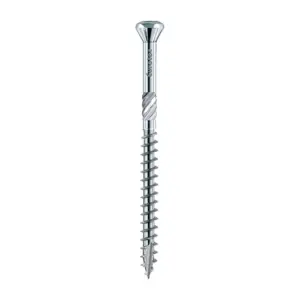 Hapatec stainless - decking screw for hardwood, hardened stainless steel
144,62 zł - 363,69 zł incl. VAT
Hapatec stainless - decking screw for hardwood, hardened stainless steel
144,62 zł - 363,69 zł incl. VAT
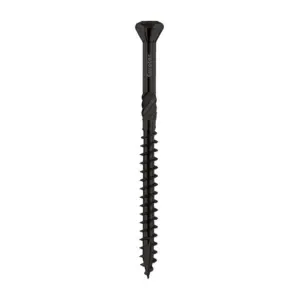 Hapatec black - screw for cladding and decking boards
159,11 zł - 496,38 zł incl. VAT
Hapatec black - screw for cladding and decking boards
159,11 zł - 496,38 zł incl. VAT
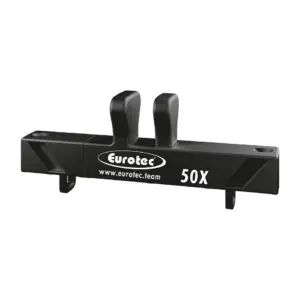 Drill Tool 50X - jig for invisible decking fixing
74,10 zł - 204,46 zł incl. VAT
Drill Tool 50X - jig for invisible decking fixing
74,10 zł - 204,46 zł incl. VAT
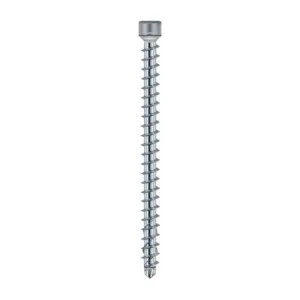 KonstruX Full Thread - Cylinder Head
102,43 zł - 789,03 zł incl. VAT
KonstruX Full Thread - Cylinder Head
102,43 zł - 789,03 zł incl. VAT